
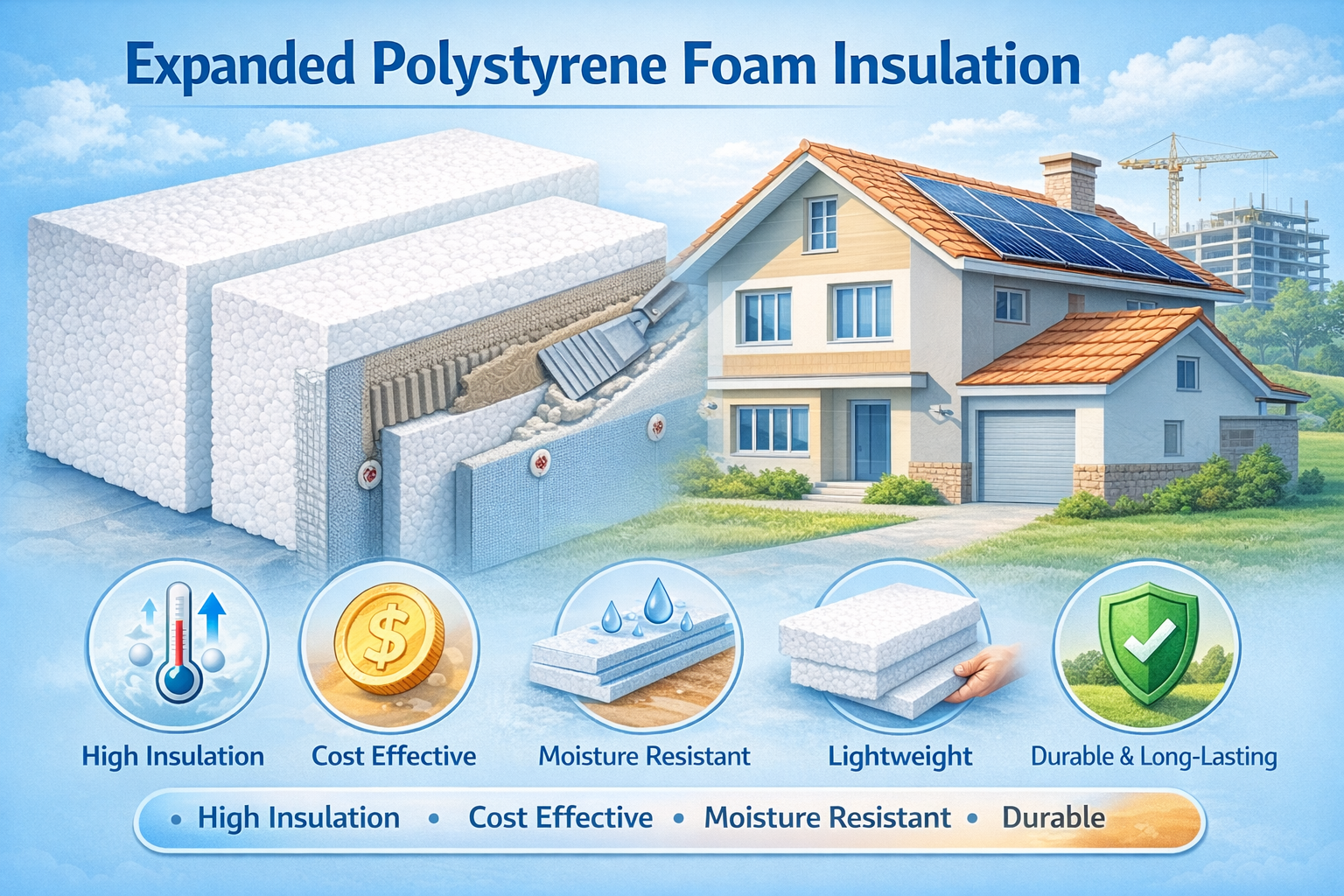
Modern construction increasingly relies on materials that deliver durability, energy efficiency, and cost effectiveness. Expanded polystyrene foam insulation has become one of the most widely used thermal insulation materials in residential, commercial, and industrial buildings. Engineers and construction professionals prefer it because it offers excellent thermal resistance, lightweight structure, moisture resistance, and long-term performance.
In particular, expanded polystyrene insulation board plays a critical role in improving building envelope performance. From wall insulation systems to roofing and foundation protection, this versatile material helps reduce energy consumption and improve indoor comfort.
This comprehensive guide explores how expanded polystyrene foam insulation works, its technical properties, applications, advantages, and why it continues to dominate modern insulation systems.
What is Expanded Polystyrene Foam Insulation?
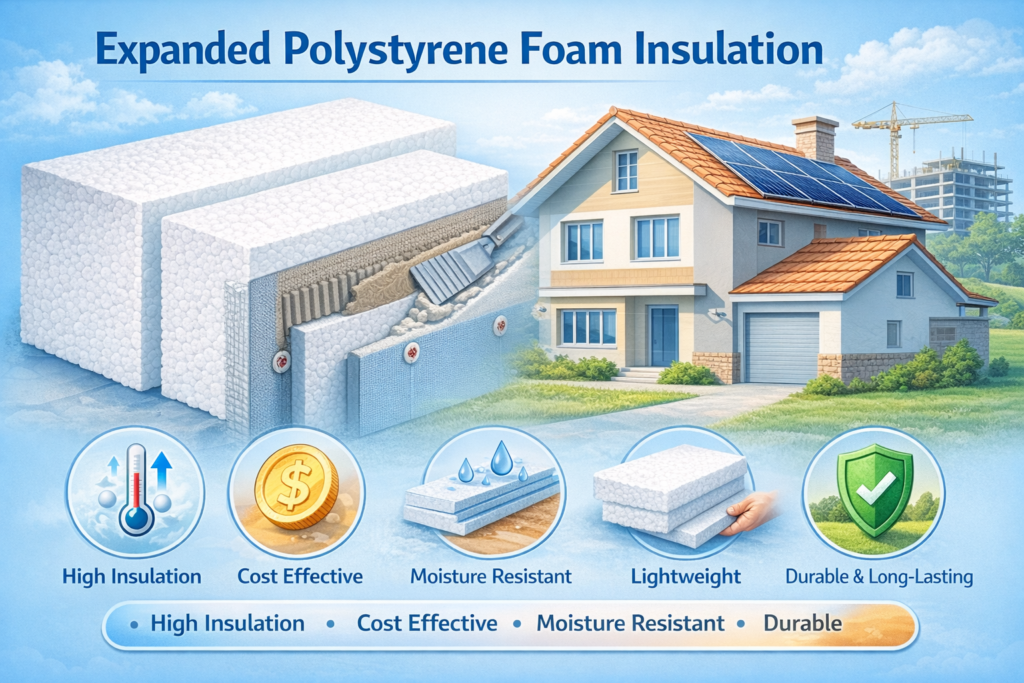
Expanded polystyrene foam insulation (EPS) is a rigid cellular plastic insulation material produced from polystyrene beads. During manufacturing, the beads expand with steam and fuse together to form lightweight foam blocks or boards.
The resulting material contains approximately 98% air and only 2% polystyrene, which explains its exceptional thermal insulation properties.
EPS insulation boards are commonly used in:
-
Exterior wall insulation systems
-
Roofing insulation
-
Underfloor insulation
-
Cold storage facilities
-
Structural insulated panels (SIPs)
Because of its stable thermal performance and low water absorption, expanded polystyrene insulation board remains one of the most efficient insulation solutions available today.
How Expanded Polystyrene Foam Insulation is Manufactured
The production process of EPS insulation involves several technical stages.
1. Pre-Expansion
Polystyrene beads contain a blowing agent, usually pentane. When exposed to steam, the beads expand up to 40–50 times their original size, creating closed-cell foam particles.
2. Aging and Stabilization
After expansion, the beads stabilize for several hours to allow internal pressure to equalize and air to replace the blowing agent.
3. Molding
The expanded beads are placed in molds and exposed to steam again. The heat fuses them into solid foam blocks or shapes.
4. Cutting and Finishing
Large blocks are cut into expanded polystyrene insulation boards with various thicknesses and densities for different construction applications.
Technical Properties of Expanded Polystyrene Foam Insulation
Understanding the technical characteristics of EPS helps engineers select the right insulation system.
Thermal Conductivity
One of the most important features of expanded polystyrene foam insulation is its low thermal conductivity.
Typical values range between:
0.032 – 0.038 W/mK
This means EPS effectively slows heat transfer through building structures.
High R-Value Performance
EPS provides a stable R-value over time because the air trapped in its cells does not easily escape.
Typical insulation performance:
-
R-3.6 to R-4.2 per inch thickness
This performance helps reduce heating and cooling costs significantly.
Lightweight Structure
EPS is extremely lightweight, with densities typically between:
-
10 kg/m³ to 35 kg/m³
This property simplifies installation and reduces structural load.
Moisture Resistance
The closed-cell structure limits water absorption. This makes expanded polystyrene insulation board ideal for:
-
Foundation insulation
-
Exterior insulation systems
-
Below-grade construction
Compressive Strength
Depending on density, EPS offers compressive strengths between:
-
70 kPa – 250 kPa
This makes it suitable for load-bearing insulation applications such as floors and roofs.
Why Expanded Polystyrene Foam Insulation is Popular in Construction

EPS insulation has gained global popularity for several reasons.
1. Exceptional Energy Efficiency
Buildings account for nearly 40% of global energy consumption according to the International Energy Agency.
Installing expanded polystyrene foam insulation significantly reduces heat transfer through walls, roofs, and floors.
As a result, buildings maintain stable indoor temperatures while using less heating and cooling energy.
2. Cost-Effective Insulation Solution
Compared with many insulation materials, EPS offers a strong balance between performance and cost.
Advantages include:
-
Low manufacturing cost
-
Easy transportation
-
Minimal installation labor
-
Long service life
This combination makes expanded polystyrene insulation board attractive for both residential and large commercial projects.
3. Durability and Long Lifespan
EPS does not rot, decay, or lose thermal performance over time.
Studies show that EPS insulation can maintain its thermal properties for 50 years or more when properly installed.
4. Environmentally Efficient
Modern EPS manufacturing uses pentane blowing agents, which have zero ozone depletion potential.
In addition:
-
EPS is recyclable
-
Requires less raw material than many alternatives
-
Reduces building energy consumption
These factors contribute to sustainable building practices.
Common Applications of Expanded Polystyrene Foam Insulation
The versatility of expanded polystyrene foam insulation allows it to be used across many construction sectors.
Exterior Wall Insulation Systems
EPS boards are widely used in Exterior Insulation and Finish Systems (EIFS).
Benefits include:
-
Improved building thermal envelope
-
Reduced thermal bridging
-
Smooth exterior finishing
Roof Insulation
Flat roofs and pitched roofs frequently use expanded polystyrene insulation board because it provides high thermal resistance while remaining lightweight.
Foundation and Basement Insulation
EPS performs well in below-grade environments due to its moisture resistance.
It protects foundations from:
-
Heat loss
-
Frost damage
-
Soil moisture
Floor Insulation
EPS insulation boards installed under concrete slabs improve thermal comfort and reduce heat loss in ground floors.
Cold Storage and Industrial Applications
The food storage industry relies heavily on expanded polystyrene foam insulation for:
-
Refrigeration panels
-
Cold rooms
-
Insulated containers
EPS vs Other Insulation Materials
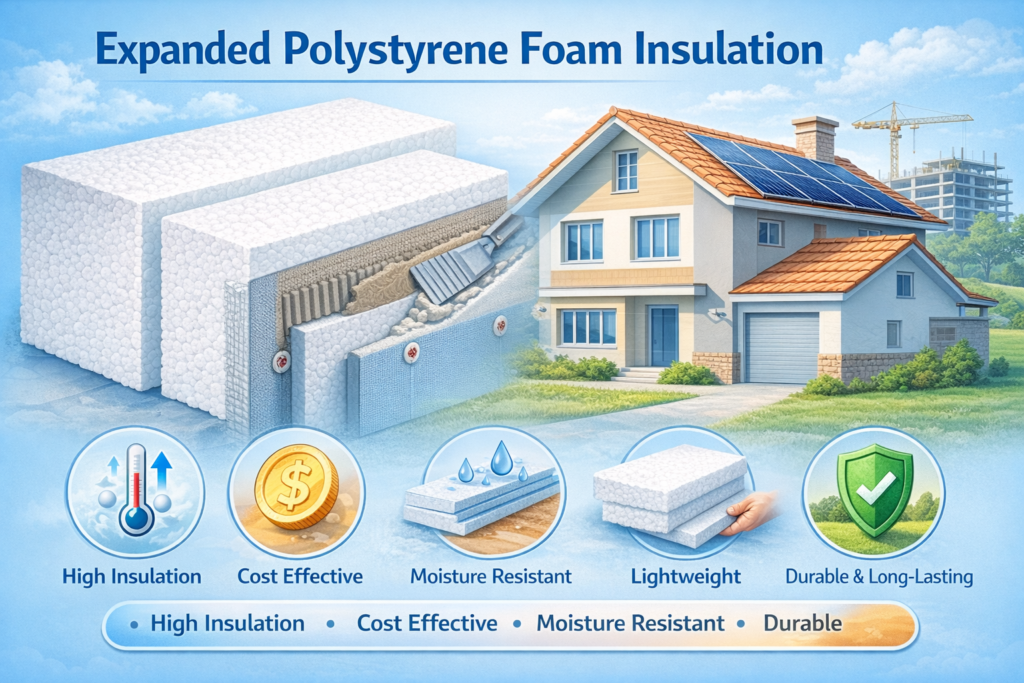
Understanding how EPS compares with alternative insulation materials helps builders choose the best solution.
| Insulation Material | Thermal Conductivity | Cost | Moisture Resistance |
|---|---|---|---|
| EPS Insulation | 0.032–0.038 W/mK | Low | Excellent |
| Extruded Polystyrene (XPS) | 0.029–0.034 W/mK | Higher | Very High |
| Mineral Wool | 0.035–0.045 W/mK | Moderate | Moderate |
| Polyurethane Foam | 0.022–0.028 W/mK | High | Excellent |
Although polyurethane has slightly better thermal conductivity, expanded polystyrene insulation board remains more cost-effective for large-scale construction projects.
Installation Best Practices for EPS Insulation Boards
Proper installation ensures optimal performance.
Surface Preparation
The substrate must be clean, dry, and level before installing EPS boards.
Adhesive Application
Builders typically use specialized polystyrene adhesives or mechanical fasteners to attach insulation boards to walls and roofs.
Joint Sealing
Sealing joints prevents thermal bridging and air infiltration.
Protective Coating
EPS insulation installed outdoors requires a protective layer such as:
-
Cement-based render
-
Fiberglass mesh reinforcement
-
Exterior cladding
These layers improve durability and weather resistance.
Fire Safety Considerations
While expanded polystyrene foam insulation is combustible, modern building systems incorporate fire protection measures.
Fire safety strategies include:
-
Flame-retardant EPS formulations
-
Protective plaster or render coatings
-
Fire-rated wall assemblies
When installed correctly within building systems, EPS meets most international building codes.
Sustainability and Environmental Impact
Energy-efficient buildings are essential for reducing carbon emissions.
EPS contributes to sustainability by:
-
Reducing heating and cooling energy demand
-
Lowering overall building emissions
-
Being recyclable into new products
According to the European Manufacturers of Expanded Polystyrene (EUMEPS), EPS insulation can save up to 200 times the energy used in its production over its lifetime.
Future Trends in Expanded Polystyrene Foam Insulation
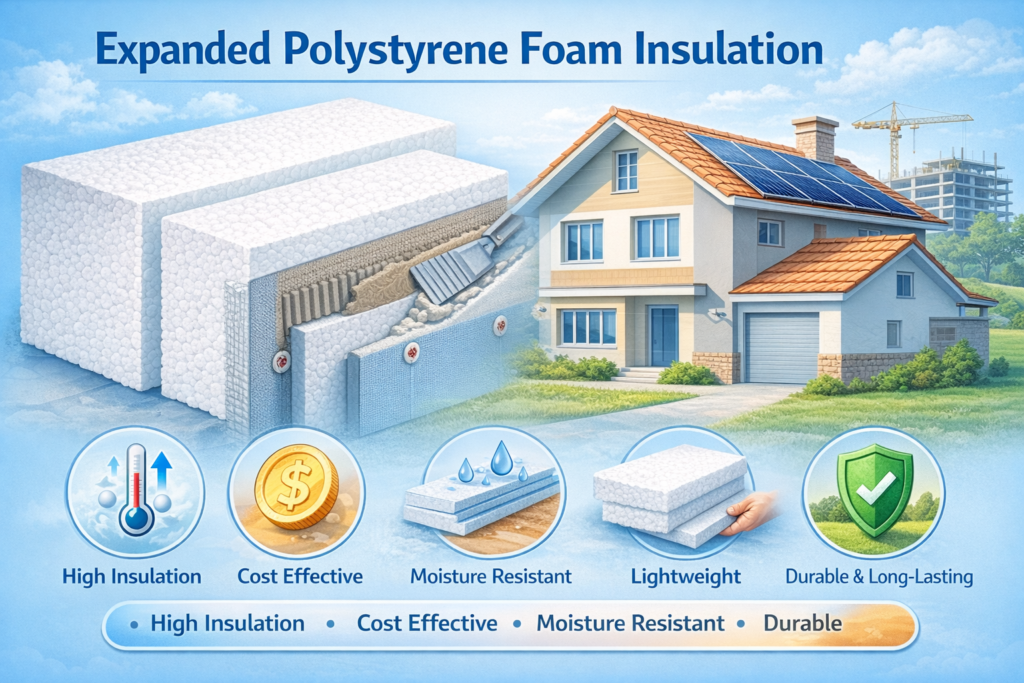
The global insulation market continues to grow as energy efficiency regulations become stricter.
Emerging trends include:
-
High-performance EPS with improved R-values
-
Graphite-enhanced EPS insulation
-
Advanced prefabricated wall systems
-
Smart building insulation integration
These innovations ensure that expanded polystyrene insulation board will remain a key material in modern construction.
Recommended Post: Polystyrene Melting Point: Temperature Limits, Thermal Behavior, and Engineering Applications
Frequently Asked Questions (FAQ)
What is expanded polystyrene foam insulation used for?
Expanded polystyrene foam insulation is commonly used for wall insulation, roof insulation, floor insulation, and foundation protection in residential and commercial buildings.
Is expanded polystyrene insulation board waterproof?
EPS is not fully waterproof, but it has very low water absorption due to its closed-cell structure. This makes it highly resistant to moisture.
How long does EPS insulation last?
Properly installed EPS insulation can last 50 years or more without losing significant thermal performance.
Is expanded polystyrene foam insulation safe?
Yes. EPS insulation is widely used in construction and meets international safety standards when installed with proper fire protection systems.
What is the R-value of expanded polystyrene insulation?
EPS typically provides an R-value of R-3.6 to R-4.2 per inch, depending on density and manufacturing quality.
Can expanded polystyrene insulation be recycled?
Yes. EPS can be recycled and reused in new insulation products or plastic materials.
Is EPS insulation environmentally friendly?
EPS helps reduce building energy consumption, which significantly lowers carbon emissions over the building’s lifespan.
Conclusion
Expanded polystyrene foam insulation remains one of the most effective and widely used thermal insulation materials in modern construction. Its combination of lightweight structure, excellent thermal resistance, moisture protection, and cost efficiency makes it ideal for residential, commercial, and industrial applications.
Builders and engineers rely on expanded polystyrene insulation board to improve building energy performance, reduce operating costs, and enhance indoor comfort. With proven durability and stable thermal performance, EPS continues to support the development of energy-efficient buildings worldwide.
As energy regulations become stricter and sustainability becomes a global priority, insulation materials like EPS will play an increasingly important role in reducing environmental impact.
If you are planning a construction project or looking to improve building insulation, consider exploring high-quality polystyrene boards and modern EPS insulation solutions to achieve long-term energy savings and structural performance.