
The EPS board cost per sheet in the United States is a critical metric for contractors, architects, developers, and homeowners aiming to balance cost efficiency with high-performance insulation. Expanded Polystyrene (EPS) remains one of the most widely used insulation materials in the U.S. construction market due to its affordability, thermal efficiency, and versatility.
With rising energy efficiency standards, stricter building codes (such as IECC compliance), and fluctuating raw material costs, understanding EPS pricing dynamics is essential for making informed procurement decisions. This guide provides a detailed, data-driven analysis of EPS board pricing across the U.S. market, including cost breakdowns, influencing factors, and practical cost-saving strategies.
What Is an EPS Board?
Expanded Polystyrene (EPS) is a rigid, closed-cell foam insulation manufactured by expanding polystyrene beads with steam and molding them into sheets or blocks.
Common U.S. Applications
- Exterior wall insulation (EIFS systems)
- Roof insulation
- Below-grade foundation insulation
- Structural Insulated Panels (SIPs)
- Cold storage and refrigerated facilities
Key Performance Properties
- Thermal conductivity: 0.032–0.038 W/mK
- R-value: ~3.6–4.2 per inch
- Density: 0.9–2.5 lb/ft³
- Compressive strength: 10–60 psi
These specifications directly influence the EPS board cost per sheet, especially in performance-driven U.S. construction projects.
EPS Board Cost Per Sheet in the U.S. (2026)
Average Price Range (Retail & Contractor Pricing)
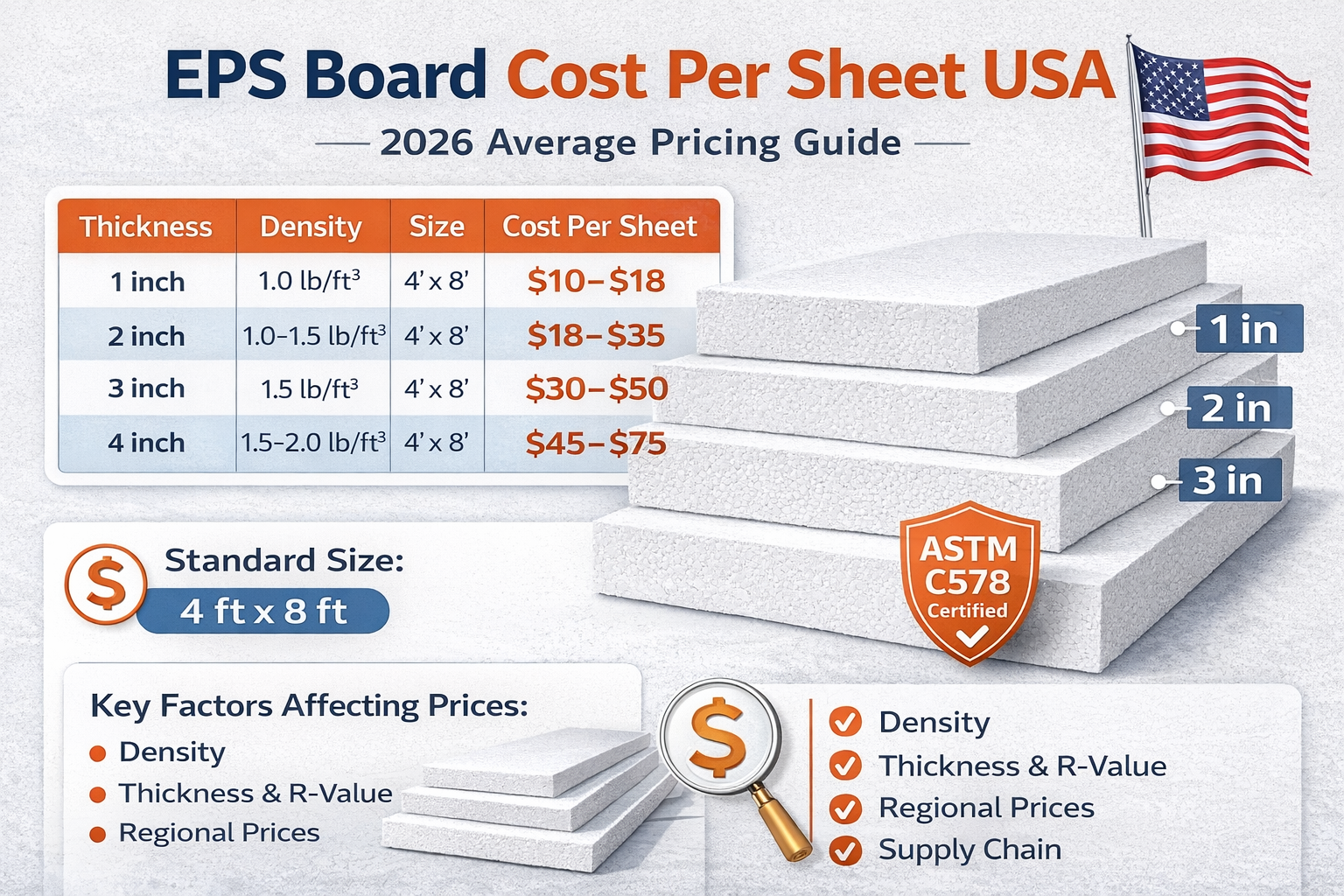
The EPS board cost per sheet in the U.S. typically depends on thickness, density, and ASTM classification.
| Thickness | Density | Size | Cost Per Sheet (USD) |
|---|---|---|---|
| 1 inch | 1.0 lb/ft³ | 4′ x 8′ | $10 – $18 |
| 2 inch | 1.0–1.5 lb/ft³ | 4′ x 8′ | $18 – $35 |
| 3 inch | 1.5 lb/ft³ | 4′ x 8′ | $30 – $50 |
| 4 inch | 1.5–2.0 lb/ft³ | 4′ x 8′ | $45 – $75 |
Expert Insight: Bulk contractor pricing can reduce the EPS board cost per sheet by 15–30%, especially for commercial-scale orders.
Key Factors Affecting EPS Board Cost Per Sheet in the U.S.
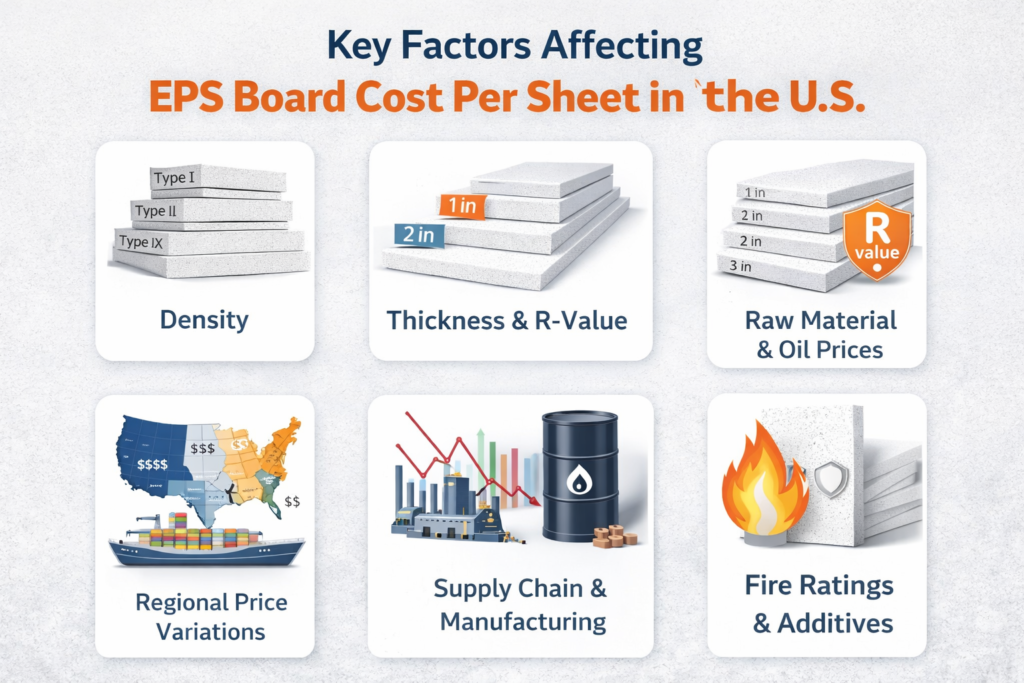
1. Density (ASTM C578 Classification)
EPS in the U.S. is categorized under ASTM C578 types:
- Type I (0.9 lb/ft³): Lowest cost, light insulation
- Type IX (1.35 lb/ft³): Standard construction
- Type II (1.5 lb/ft³): Most commonly used
- Type VIII / XIV: High-strength applications
Impact: Moving from Type I to Type II can increase the EPS board cost per sheet by 20–40%.
2. Thickness and R-Value Requirements
U.S. building codes (IECC) often dictate minimum R-values:
- Walls: R-13 to R-21
- Roofs: R-30 to R-49
Thicker EPS boards are required to meet these standards, increasing cost.
Example:
A 4-inch EPS board (R-16) costs significantly more than a 1-inch board (R-4).
3. Regional Price Variations
EPS pricing varies across the U.S.:
- Northeast & West Coast: Higher due to labor and logistics
- Midwest & South: More competitive pricing
Transportation distance from manufacturing plants also impacts cost.
4. Raw Material and Oil Prices
EPS is derived from styrene, a petroleum byproduct. Therefore:
- Oil price fluctuations impact production cost
- Supply chain disruptions can cause price volatility
5. Supply Chain and Manufacturing Capacity
- Domestic production vs imported materials
- Demand from construction and packaging industries
During high construction demand periods, the EPS board cost per sheet may increase.
6. Fire Ratings and Additives
EPS boards used in the U.S. often include:
- Flame retardants (per building code)
- Specialized coatings
These enhancements can increase cost by 5–15%.
EPS vs Other Insulation Materials (U.S. Market)
| Material | Cost Per Sheet | R-Value | Use Case |
|---|---|---|---|
| EPS | Low | Moderate | General insulation |
| XPS | Medium | Higher | Moisture-resistant applications |
| Polyiso | Medium–High | Very High | Roofing systems |
| Spray Foam | High | Excellent | Air sealing |
Conclusion: EPS remains the most cost-effective option for large-scale insulation projects.
Cost Efficiency and ROI in U.S. Projects
Energy Savings
EPS insulation can reduce heating and cooling costs by 20–40% annually, depending on climate zone.
Lifecycle Value
- Lifespan: 30–50 years
- Minimal degradation
- Stable R-value over time
This makes the EPS board cost per sheet a high-value investment despite upfront expenses.
Practical Ways to Reduce EPS Board Cost Per Sheet
1. Bulk Procurement
- Large orders reduce per-sheet cost
- Ideal for developers and contractors
2. Optimize Specification
- Avoid over-specifying density
- Match board type to application
3. Source Locally
- Reduces freight cost
- Improves delivery timelines
4. Work with Certified Suppliers
- Ensures ASTM compliance
- Reduces risk of material failure
Installation Considerations
Even with a competitive EPS board cost per sheet, installation quality affects total project cost.
Key Considerations:
- Adhesive compatibility
- Mechanical fasteners
- Vapor barriers
- Code compliance
Tip: Improper installation can reduce insulation performance by up to 25%.
Sustainability and Environmental Impact
EPS is increasingly aligned with U.S. sustainability goals:
- 100% recyclable
- Low global warming potential
- Energy-efficient over lifecycle
However:
- Recycling infrastructure varies by state
- Not biodegradable
Frequently Asked Questions (FAQ)
1. What is the average EPS board cost per sheet in the U.S.?
The average EPS board cost per sheet ranges from $10 to $75 depending on thickness and density.
2. Is EPS cheaper than XPS in the U.S.?
Yes, EPS is typically 20–40% cheaper than XPS for similar applications.
3. What size is a standard EPS sheet in the U.S.?
The standard size is 4 ft x 8 ft, though custom sizes are available.
4. Does EPS meet U.S. building codes?
Yes, when manufactured to ASTM C578 standards and installed correctly.
5. How long does EPS insulation last?
EPS can last 30–50 years with minimal performance loss.
6. Is EPS suitable for below-grade insulation?
Yes, but higher-density EPS is recommended for moisture resistance and durability.
7. Can EPS boards be reused or recycled?
Yes, EPS is recyclable and can be reused in certain applications.
Conclusion
The EPS board cost per sheet in the U.S. is influenced by multiple technical and economic factors, including density, thickness, ASTM classification, and regional supply conditions. Despite market fluctuations, EPS remains one of the most cost-effective insulation materials available, offering an excellent balance between performance and affordability.
For contractors, developers, and homeowners, the key to maximizing value lies in understanding specification requirements, sourcing strategically, and ensuring proper installation. By doing so, EPS boards can deliver long-term energy savings, durability, and compliance with modern building standards.
If you’re planning a construction or retrofit project, now is the ideal time to explore EPS insulation solutions tailored to U.S. building requirements. Evaluate your project needs carefully, compare supplier offerings, and invest in materials that provide both immediate cost savings and long-term performance benefits.